

Every so often, I receive queries in my mailbox asking about various topics. Today, I was asked an astronomy question that intrigued me:
"Under enormous magnification, such as the HUBBLE - WHY ON EARTH don't individual stars, when focused on, look absolutely ENORMOUS. I mean - focus on a GALAXY, and you see an object otherwise 'apparently' tiny, blown up to be quite visible in detail. However I have yet to see a SINGLE IMAGE of ANY star, that makes it look even REMOTELY like our SUN. Please explain to my satisfaction and I will be DELIGHTED."
This is perhaps a not so uncommon misconception. So, I set about to compile the answer, replied in detail and I share it with you here:
Well, stars are small. Compared to the structure of galaxies, which are made up of billions of stars, one star makes up only a very tiny portion of that gathering we see in an image. Our galaxy is composed of 100-400 billion stars, depending upon the estimation method used to compute the value. So, at best, our Sun makes up one one hundred billionth (1/100,000,000,000) of the galaxy and the distance to the next star out from us is huge. It takes the light emitted from it 4.2 years to reach us. The measurements we are talking about, compared to the cross section of a star's disk, are enormous.
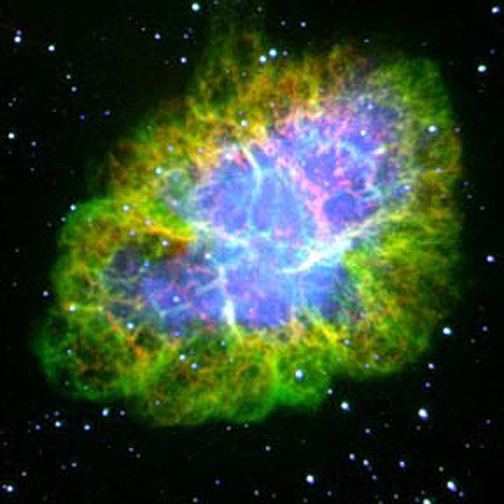
The Crab Nebula in Optical Wavelengths
Our Sun is 865,000 miles (1.4 million km) in diameter and is, on average, 92,955,887.6 miles (149,597,999.97373 km) distant. But seen at the distance of, say, the Crab Nebula; which is about 6,500 light years, it appears really small.
One light year is the distance that a ray of light travels while we orbit the Sun once and equals 5,878,499,814,135.1 miles (9,460,528,404,879.4 km). You can see that 865,000 miles in comparison to 5.878 trillion miles is pretty tiny. It would take 96,997,124,660,000,000 Suns lined up next to each other to measure the distance to the nebula. At that distance, stars just cannot be resolved by today's instruments and they appear as points. The only way we can see them at all is because they are very bright.
In comparison to a galaxy, a star's diameter is even smaller. The Crab Nebula in the example above, is in our galaxy. The nebula's major diameter, as seen from Earth, is 11 light years. That is 74,761,519.54 times the diameter of the Sun. Our galaxy is about 100,000 light years in diameter. We are 28,000 light years from its center and 22,000 light years from the nearest edge, so the Crab Nebula, at "only" 6,500 light years, is a lot closer to us.
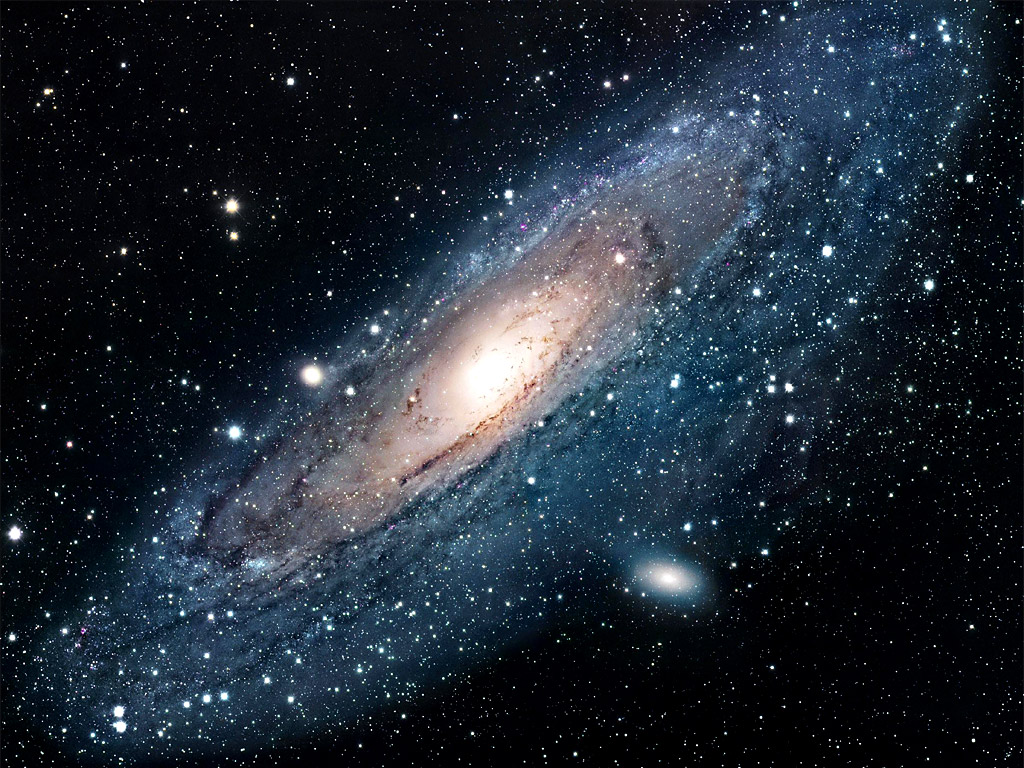
The Andromeda Galaxy - © Robert Gendler
Seeing a galaxy in an image and realizing how large it really is, you can now begin to (although we never really can) grasp the relative sizes that we are dealing with. The Andromeda galaxy, once considered to be our "sister" galaxy due to its like size and shape, has been shown to be much larger. It is composed of approximately 1,000,000,000,000 stars, is 220,000 light years in diameter and is 2,540,000 light years distant from us—33,076 times the distance to the Crab Nebula. That's a LOT of Sun diameters. If you know where to look in the night sky, you can see it without a telescope. One star in it may be visible as a disk some day but the technology to be able to do that is unimaginable at this point.
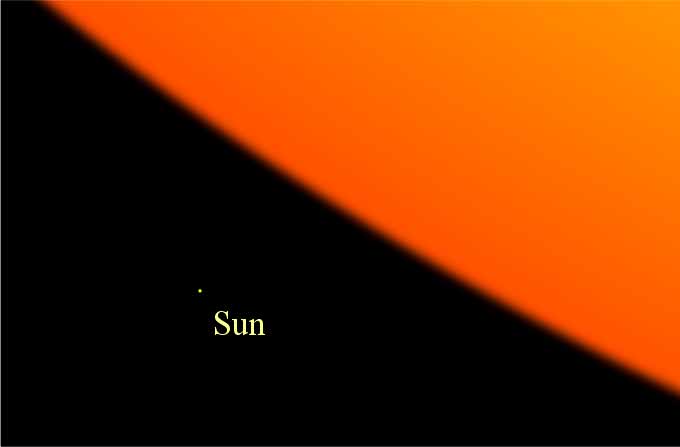
VY Canis Majoris
The Universe is a Big Place and I hope that you are delighted to be part of it and understand it a bit better. When next you go out to look at the night sky, reflect on these distances and your troubles, however large they may seem, will just melt away.
It was upon sending my reply that I noticed the email address from which the query came: [username]@uoregon.edu
I hope you get an "A". 😉
Have an Astronomy or Spaceflight question? Post a comment and I'll see if I can answer it.Tags: distance, galaxy, Hubble, nebula, relative, space, star, telescope, universe
Short URL for this post: //spherical.org/s/e


 RSS - Posts
